
.png)
CloudAnalogy, a Salesforce Summit Consulting Partner with delivery centers across India and offices in the US, UK, and Australia, is entering a decisive expansion phase as it aligns its fast-growing multi-cloud CRM services business with a new AI orchestration layer built around the IntelliMate platform. The company has grown to a team in the several-hundreds range and reports strong global revenues while supporting thousands of customers across industries. With hundreds of Salesforce and CRM implementations delivered and a product portfolio that includes tools like PinTags, Mc-Utility, FilestoFolder, Campaign Bridge, and GlowNowX, CloudAnalogy is moving beyond traditional SI work into a hybrid model that blends consulting, in-house accelerators, and AI-enabled delivery. Its partnerships across the Salesforce ecosystem, combined with consistent hiring and leadership investment in engineering, data, and marketing functions, position CloudAnalogy as a company shifting from project execution to full-funnel CRM transformation — a signal that it is becoming an important player to watch in the convergence of Salesforce services, automation, and applied AI.
CloudAnalogy wanted to build a pipeline with enterprise grade accounts in the Salesforce consulting space in the US. These meetings are notoriously difficult to secure – you usually need a large SDR team, RevOps support, and AEs to make it work. Their challenges were clear: Salesforce consulting is a commodity service, responses from enterprise companies are hard to get, and they had just one week to start seeing results all under a limited budget. This brings us to the point how CloudAnalogy automated the process end-to-end with an agent? This would save both cost and time. Because the workflow is automated, we can quickly deploy and start generating outcomes.
The CloudAnalogy team wanted to build an acquisition system that must have everything in one place — access to 15+ custom account databases, signal-based TAM segmentation, automated enrichment, scoring, and qualification. They needed fast list creation, 1:1 personalized icebreakers, campaign scheduling, contextual follow-ups, and automated routing of interested leads. Email infrastructure, deliverability setup, and two-way CRM sync had to be included – no stitching tools together. What made it work wasn’t just the features, but the hands-on support.
The Team needed clearer ways to identify high-fit accounts. Signals like Agentforce Need, US HQ, and Real Estate Niche highlighted product fit, geographic viability, and industry relevance. Their existing filters lacked precision and created noise in the targeting. These signals helped narrow the list to accounts with higher intent. This improved focus boosted conversion potential.
.png)
CloudAnalogy wanted to automate a specific workflow to run outreach in the US for a niche solution.
Signal 1: Agentforce Need – Companies showing requirements or dependencies on Agentforce.
Signal 2: US HQ – Companies headquartered in the United States.
Signal 3: Real Estate Niche – Companies operating specifically in the real-estate niche.
Now, let’s take a look at how the GTM Agent put this into action.
.png)
The GTM Agent targeted accounts matching the above signals and turned high-intent leads into warm conversations without any manual follow-ups from the founder. This gave the team bandwidth to focus on closing, while outbound ran on autopilot.
Challenge: The manual, time-intensive process of finding companies actively hiring.
Solution: An AI-powered workflow implemented to automate lead identification, research, and qualification.
Let’s take a look at the flow run by the AI Agent for CloudAnalogy
CloudAnalogy AI Agent Process and Steps:
The CloudAnalogy custom AI Agent begins with a simple input and immediately scans multiple sources across the public web for companies that show Agentforce requirements.
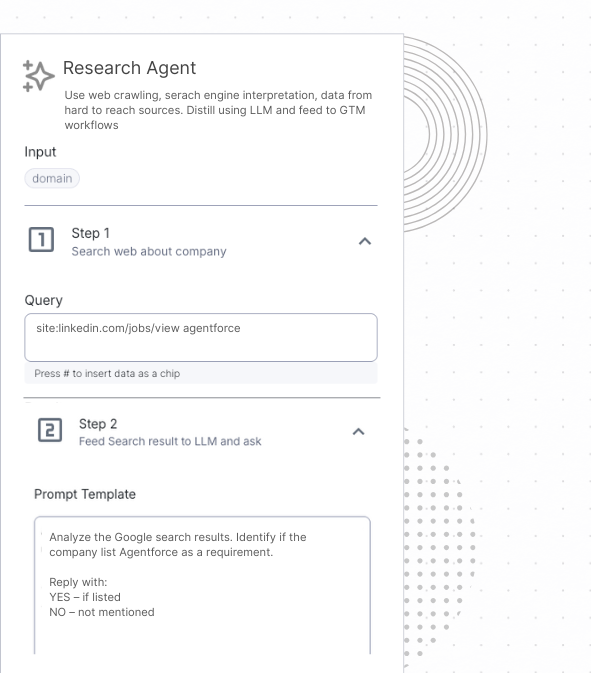
Next, the AI Agent scores and qualifies accounts based on niche fit (Real Estate) and US HQ, promoting only high-fit accounts to outreach.
It then identifies the right decision-makers and enriches their profiles with verified email addresses. Once ready, the system pushes all signal-qualified, scored data into your CRM or email sequencer (like Smartlead) to power highly targeted outbound campaigns.
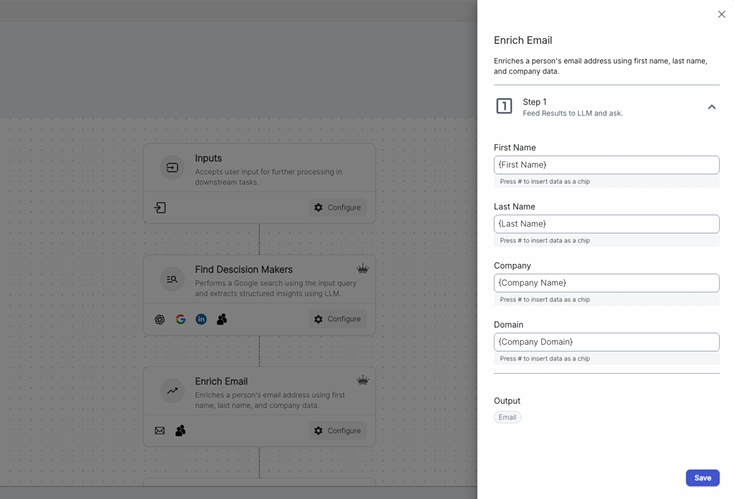
This end-to-end automation helps sales teams skip hours of manual research and focus only on high-probability conversations.
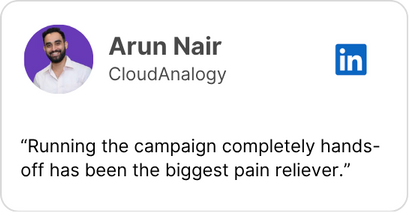
Human-in-the-Loop Campaign Management While GTM Agents are autonomous, every campaign benefits from an expert-led human-in-the-loop (HITL) architecture that ensures precision, adaptability, and reliability—especially in complex SaaS and GTM environments where AI alone may fall short.
The campaign engine is supported by real humans with deep expertise in GTM systems, making the service resilient, customizable, and highly contextual.
What This Means for the CloudAnalogy Team:
● No DIY configurations — Our team handles all technical setup, infrastructure, and sequencing logic.
● No risk of failure — If the AI agent cannot process a domain, extract signals, or validate contacts, our human experts step in immediately.
CloudAnalogy team saw immediate and measurable impact
Reps save 10–12 hours weekly by removing manual research and list cleanup. Seamless handoff to human SDRs focused only on high-value conversations
Reps finally stopped burning time on low-intent lists and instead focused on accounts that were already heating up.
.png)
.png)
Outbound meetings surged once the GTM Agent started flagging real buying signals.
2x increase in total meetings booked
.png)
CloudAnalogy plans to extend the GTM Agent through:
More personalized chat conversations
Automated follow-up sequences
Spotlight-based targeting for higher-quality outreach

This section uses a container element to ensure the content looks right on every device. It’s centered with the class “Centered Container.”
Convert!If you're targeting customer service managers, than you'll need a pitch that completely resonates with them.
But how do you write emails that strike are a perfect balance between promoting your business but not being too self-centered?
In this article, Sacha, CEO of Growth Room, shows how social proof helps you transform a cold email into a powerful tool that books meetings!

Here's an example of a cold email that targets customer service (CS) managers in e-commerce to sell an AI-powered CS platform 👇

Here are Sacha’s insights on what needs to be improved to get more replies:
Mistake #1 → Too promotional subject line
Avoid using popular marketing and sales keywords such as “boost”, “customer service”, and “AI” which won’t make your cold email stand out in prospects’ inboxes.
Mistake #2 → Self-centered intro line
The intro line should catch prospects’ attention by talking about them and what you can do for them. Talking about yourself won’t bring them value and interest them in reading the rest of your email.
Mistake #3 → Not-visible CTA
Because your prospects usually scan emails before reading them, adding a space line before the ending line will make their next step more clear.
Mistake #4 → Spam words
If you want to ensure your messaging gets through, avoid using spam words like “free”. Those words trigger the spam filters and land your emails in the spam folder where your target audience can’t read them.
Here is how Sacha would rewrite the previous cold email and his tips for booking more meetings!

Tip #1 → Focus on your prospect
If you want to get replies to your cold emails - talk about their company, compliment them, and ensure the majority of your email is focused on them and how to achieve their goals.
Tip #2 → Give a glimpse of the value you bring
By leveraging social proof, you can showcase prospects’ desired outcomes and tease them into replying. Mention clients and their results from relevant industries to build trust and credibility.
Tip #3 → Position yourself as an expert
Position yourself as a problem solver. Once you show your leads that you understand their pain point and know how to solve it, it will make your product/service more relevant.
Tip #4 → Non-intrusive CTA
Instead of talking about demos, ask for less effort and talk about catching up over a call/meeting. It will sound less salesy and push your prospects to reply.
Here are Sacha’s tips for effective cold emailing to sell AI-powered platforms to e-commerce CS managers:
-> Focus on the recipient, highlighting their company and goals
-> Utilize social proof relevant to their industry to establish trust
-> Position yourself as a solution to their specific challenges
-> Use a non-intrusive call-to-action, like suggesting a casual call or meeting instead of demo
Cold emails work effectively when they are targeted, personalized, clear, and part of a well-thought sales strategy.
Here are 5 best practices that will make your cold outreach effective and help you get results:
Cold emails can be effective when they are highly targeted. This means understanding the recipient's industry, role, and potential needs, and then crafting an email that speaks directly to those factors.
A key element of successful cold emails is personalization. This goes beyond just using the recipient's name; it involves tailoring the message to address their specific challenges or interests.
The effectiveness of a cold email is often tied to its clarity. As the majority of recipients first scan cold emails, they are more likely to engage with the ones that get to the point quickly and offer a clear value proposition.
Persistence in cold outreach pays off! Follow-up emails, when done respectfully and increasing the value, can boost the chances of getting a reply.
The success of cold emails should be measured not just by open or response rates, but also by the quality of the interactions they initiate (e.g., established connections, closed deals)
Salesloft can be used in Large Enterprises, Mid Size Business, Non Profit, Public Administrations, and Small Businesses.
It was built for the entire revenue teams to optimize customer journey:
CloudAnalogy, a Salesforce Summit Consulting Partner with delivery centers across India and offices in the US, UK, and Australia, is entering a decisive expansion phase as it aligns its fast-growing multi-cloud CRM services business with a new AI orchestration layer built around the IntelliMate platform. The company has grown to a team in the several-hundreds range and reports strong global revenues while supporting thousands of customers across industries. With hundreds of Salesforce and CRM implementations delivered and a product portfolio that includes tools like PinTags, Mc-Utility, FilestoFolder, Campaign Bridge, and GlowNowX, CloudAnalogy is moving beyond traditional SI work into a hybrid model that blends consulting, in-house accelerators, and AI-enabled delivery. Its partnerships across the Salesforce ecosystem, combined with consistent hiring and leadership investment in engineering, data, and marketing functions, position CloudAnalogy as a company shifting from project execution to full-funnel CRM transformation — a signal that it is becoming an important player to watch in the convergence of Salesforce services, automation, and applied AI.
CloudAnalogy wanted to build a pipeline with enterprise grade accounts in the Salesforce consulting space in the US. These meetings are notoriously difficult to secure – you usually need a large SDR team, RevOps support, and AEs to make it work. Their challenges were clear: Salesforce consulting is a commodity service, responses from enterprise companies are hard to get, and they had just one week to start seeing results all under a limited budget. This brings us to the point how CloudAnalogy automated the process end-to-end with an agent? This would save both cost and time. Because the workflow is automated, we can quickly deploy and start generating outcomes.
The CloudAnalogy team wanted to build an acquisition system that must have everything in one place — access to 15+ custom account databases, signal-based TAM segmentation, automated enrichment, scoring, and qualification. They needed fast list creation, 1:1 personalized icebreakers, campaign scheduling, contextual follow-ups, and automated routing of interested leads. Email infrastructure, deliverability setup, and two-way CRM sync had to be included – no stitching tools together. What made it work wasn’t just the features, but the hands-on support.
The Team needed clearer ways to identify high-fit accounts. Signals like Agentforce Need, US HQ, and Real Estate Niche highlighted product fit, geographic viability, and industry relevance. Their existing filters lacked precision and created noise in the targeting. These signals helped narrow the list to accounts with higher intent. This improved focus boosted conversion potential.
CloudAnalogy wanted to automate a specific workflow to run outreach in the US for a niche solution.
Signal 1: Agentforce Need – Companies showing requirements or dependencies on Agentforce.
Signal 2: US HQ – Companies headquartered in the United States.
Signal 3: Real Estate Niche – Companies operating specifically in the real-estate niche.
Now, let’s take a look at how the GTM Agent put this into action.
The GTM Agent targeted accounts matching the above signals and turned high-intent leads into warm conversations without any manual follow-ups from the founder. This gave the team bandwidth to focus on closing, while outbound ran on autopilot.
Challenge: The manual, time-intensive process of finding companies actively hiring.
Solution: An AI-powered workflow implemented to automate lead identification, research, and qualification.
Let’s take a look at the flow run by the AI Agent for CloudAnalogy
CloudAnalogy AI Agent Process and Steps:
The CloudAnalogy custom AI Agent begins with a simple input and immediately scans multiple sources across the public web for companies that show Agentforce requirements.
Next, the AI Agent scores and qualifies accounts based on niche fit (Real Estate) and US HQ, promoting only high-fit accounts to outreach.
It then identifies the right decision-makers and enriches their profiles with verified email addresses. Once ready, the system pushes all signal-qualified, scored data into your CRM or email sequencer (like Smartlead) to power highly targeted outbound campaigns.
This end-to-end automation helps sales teams skip hours of manual research and focus only on high-probability conversations.
Human-in-the-Loop Campaign Management While GTM Agents are autonomous, every campaign benefits from an expert-led human-in-the-loop (HITL) architecture that ensures precision, adaptability, and reliability—especially in complex SaaS and GTM environments where AI alone may fall short.
The campaign engine is supported by real humans with deep expertise in GTM systems, making the service resilient, customizable, and highly contextual.
What This Means for the CloudAnalogy Team:
● No DIY configurations — Our team handles all technical setup, infrastructure, and sequencing logic.
● No risk of failure — If the AI agent cannot process a domain, extract signals, or validate contacts, our human experts step in immediately.
CloudAnalogy team saw immediate and measurable impact
Reps save 10–12 hours weekly by removing manual research and list cleanup. Seamless handoff to human SDRs focused only on high-value conversations
Reps finally stopped burning time on low-intent lists and instead focused on accounts that were already heating up.
Outbound meetings surged once the GTM Agent started flagging real buying signals.
2x increase in total meetings booked
CloudAnalogy plans to extend the GTM Agent through:
More personalized chat conversations
Automated follow-up sequences
Spotlight-based targeting for higher-quality outreach
This section uses a container element to ensure the content looks right on every device. It’s centered with the class “Centered Container.”
Convert!CloudAnalogy, a Salesforce Summit Consulting Partner with delivery centers across India and offices in the US, UK, and Australia, is entering a decisive expansion phase as it aligns its fast-growing multi-cloud CRM services business with a new AI orchestration layer built around the IntelliMate platform. The company has grown to a team in the several-hundreds range and reports strong global revenues while supporting thousands of customers across industries. With hundreds of Salesforce and CRM implementations delivered and a product portfolio that includes tools like PinTags, Mc-Utility, FilestoFolder, Campaign Bridge, and GlowNowX, CloudAnalogy is moving beyond traditional SI work into a hybrid model that blends consulting, in-house accelerators, and AI-enabled delivery. Its partnerships across the Salesforce ecosystem, combined with consistent hiring and leadership investment in engineering, data, and marketing functions, position CloudAnalogy as a company shifting from project execution to full-funnel CRM transformation — a signal that it is becoming an important player to watch in the convergence of Salesforce services, automation, and applied AI.
CloudAnalogy wanted to build a pipeline with enterprise grade accounts in the Salesforce consulting space in the US. These meetings are notoriously difficult to secure – you usually need a large SDR team, RevOps support, and AEs to make it work. Their challenges were clear: Salesforce consulting is a commodity service, responses from enterprise companies are hard to get, and they had just one week to start seeing results all under a limited budget. This brings us to the point how CloudAnalogy automated the process end-to-end with an agent? This would save both cost and time. Because the workflow is automated, we can quickly deploy and start generating outcomes.
The CloudAnalogy team wanted to build an acquisition system that must have everything in one place — access to 15+ custom account databases, signal-based TAM segmentation, automated enrichment, scoring, and qualification. They needed fast list creation, 1:1 personalized icebreakers, campaign scheduling, contextual follow-ups, and automated routing of interested leads. Email infrastructure, deliverability setup, and two-way CRM sync had to be included – no stitching tools together. What made it work wasn’t just the features, but the hands-on support.
The Team needed clearer ways to identify high-fit accounts. Signals like Agentforce Need, US HQ, and Real Estate Niche highlighted product fit, geographic viability, and industry relevance. Their existing filters lacked precision and created noise in the targeting. These signals helped narrow the list to accounts with higher intent. This improved focus boosted conversion potential.
CloudAnalogy wanted to automate a specific workflow to run outreach in the US for a niche solution.
Signal 1: Agentforce Need – Companies showing requirements or dependencies on Agentforce.
Signal 2: US HQ – Companies headquartered in the United States.
Signal 3: Real Estate Niche – Companies operating specifically in the real-estate niche.
Now, let’s take a look at how the GTM Agent put this into action.
The GTM Agent targeted accounts matching the above signals and turned high-intent leads into warm conversations without any manual follow-ups from the founder. This gave the team bandwidth to focus on closing, while outbound ran on autopilot.
Challenge: The manual, time-intensive process of finding companies actively hiring.
Solution: An AI-powered workflow implemented to automate lead identification, research, and qualification.
Let’s take a look at the flow run by the AI Agent for CloudAnalogy
CloudAnalogy AI Agent Process and Steps:
The CloudAnalogy custom AI Agent begins with a simple input and immediately scans multiple sources across the public web for companies that show Agentforce requirements.
Next, the AI Agent scores and qualifies accounts based on niche fit (Real Estate) and US HQ, promoting only high-fit accounts to outreach.
It then identifies the right decision-makers and enriches their profiles with verified email addresses. Once ready, the system pushes all signal-qualified, scored data into your CRM or email sequencer (like Smartlead) to power highly targeted outbound campaigns.
This end-to-end automation helps sales teams skip hours of manual research and focus only on high-probability conversations.
Human-in-the-Loop Campaign Management While GTM Agents are autonomous, every campaign benefits from an expert-led human-in-the-loop (HITL) architecture that ensures precision, adaptability, and reliability—especially in complex SaaS and GTM environments where AI alone may fall short.
The campaign engine is supported by real humans with deep expertise in GTM systems, making the service resilient, customizable, and highly contextual.
What This Means for the CloudAnalogy Team:
● No DIY configurations — Our team handles all technical setup, infrastructure, and sequencing logic.
● No risk of failure — If the AI agent cannot process a domain, extract signals, or validate contacts, our human experts step in immediately.
CloudAnalogy team saw immediate and measurable impact
Reps save 10–12 hours weekly by removing manual research and list cleanup. Seamless handoff to human SDRs focused only on high-value conversations
Reps finally stopped burning time on low-intent lists and instead focused on accounts that were already heating up.
Outbound meetings surged once the GTM Agent started flagging real buying signals.
2x increase in total meetings booked
CloudAnalogy plans to extend the GTM Agent through:
More personalized chat conversations
Automated follow-up sequences
Spotlight-based targeting for higher-quality outreach
.png)