
AIPlacers is building a category around deployable AI voice employees by enabling businesses to launch production-grade voice agents—receptionist, tech support, appointment setter, inbound and outbound lead handling—across phone and web channels in minutes rather than weeks, with multilingual coverage across 50+ languages and native integrations into systems like Salesforce, HubSpot, and Zapier. The platform reports adoption across 100+ active businesses and more than 1M handled calls and interactions, with customer-level outcomes showing 200+ calls per day at 95%+ accuracy, measurable lifts in reservations without booking errors, and materially higher meeting volumes from automated scheduling, all supported by a high-availability infrastructure benchmarked at 99.9% uptime. AIPlacers positions itself for high-volume, compliance-heavy front-office workflows across sectors such as hospitality, real estate, and financial services, pairing a no-code, drag-and-drop conversation builder with real-time analytics that make performance, resolution rates, and conversion metrics auditable rather than anecdotal. With security and data handling positioned around enterprise requirements (including SOC 2, GDPR, and HIPAA alignment) and pricing that spans self-serve entry tiers to custom enterprise deployments, the company is signaling a clear focus on scale, integration depth, and operational ROI—placing AIPlacers among the vendors redefining how voice operations are staffed, measured, and automated.
Companies with founder-led GTM motions often struggle to scale outbound without losing personalization or burning founder time. Identifying vetted accounts, crafting relevant outreach, and managing replies manually isn’t sustainable past a certain stage.
Team wants to know: Which accounts show buying signals? Which ones convert? Without a system, outbound becomes guesswork. That's where GTM agents step in—automating this entire flow with clarity on what’s working and why.
AIPlacers had a lean GTM team and they wanted to build an acquisition system that must have everything in one place — access to 30+ custom account databases, signal-based TAM segmentation, automated enrichment, scoring, and qualification. They needed fast list creation, 1:1 personalized icebreakers, campaign scheduling, contextual follow-ups, and automated routing of interested leads.
Email infrastructure, deliverability setup, and two-way CRM sync had to be included — no stitching tools together. What made it work wasn’t just the features, but the hands-on support.
AI Placers was trying to identify small, owner-led service businesses with clear buying authority and manageable deal cycles. They looked for dental clinics, accounting firms, and spa or wellness businesses, indicating repeatable operational needs and high service dependency. Targeting CEOs, CIOs, CTOs, or business owners signaled direct control over technology and purchasing decisions. Focusing on US-based companies with 10–50 employees suggested sufficient budget without enterprise-level complexity. Together, these signals highlighted accounts most likely to convert due to fit, authority, and speed of decision-making.
.png)
Target hot accounts with strong buying signals those rapidly expand, with both the budget and need for your product.
Act quickly to book meetings within the next 10 days, as these accounts are prime for conversion right now.
Signal 1: Industry Niche – Companies operating as dental clinics, accounting firms, or SPA / wellness businesses.
Signal 2: Target Geography – Companies based in the United States.
Signal 3: Senior Leadership ICP – Companies where the target contacts are CEO, CIO, CTO, or business owners.
Signal 4: Companies with 10–50 employees size.
Now, let’s take a look at how the GTM Agent put this into action.
.png)
The GTM Agent targeted accounts matching the above signals and turned high-intent leads into warm conversations without any manual follow-ups from the founder. This gave the team bandwidth to focus on closing, while outbound ran on autopilot.
Challenge: The manual, time-intensive process of finding companies actively hiring.
Solution: An AI-powered workflow implemented to automate lead identification, research, and qualification.
Let’s take a look at the flow run by the AI Agent for AIPlacers.
AIPlacers AI Agent Process and Steps:
The agent starts with a input for e.g. a seed list just like what an SDR. Next, the AI Agent scores and qualifies accounts based on niche fit (e.g Healthcare) and US HQ, promoting only high-fit accounts to outreach.
It then identifies the right decision-makers and enriches their profiles with verified email addresses. Once ready, the system pushes all signal-qualified, scored data into your CRM or email sequencer (like Smartlead) to power highly targeted outbound campaigns.
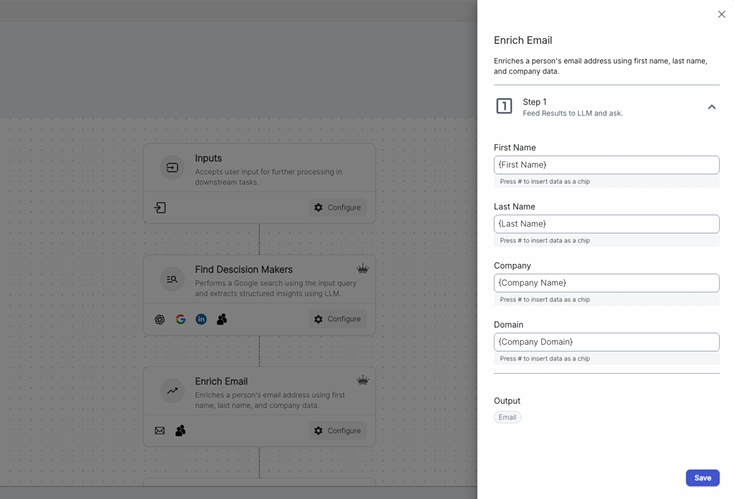
This end-to-end automation helps sales teams skip hours of manual research and focus only on high-probability conversations.
AIPlacers replaced 40 hours of manual prospecting with just 40 minutes of supervised effort
.png)
AIPlacers doesn’t just run one-size fits all programs. The team has built creative, flexible campaigns on top of custom AI Workflow.
.png)
AI Agent generated:
.png)
Human-in-the-Loop Campaign Management While GTM Agents are autonomous, every campaign benefits from an expert-led human-in-the-loop (HITL) architecture that ensures precision, adaptability, and reliability—especially in complex SaaS and GTM environments where AI alone may fall short.
The campaign engine is supported by real humans with deep expertise in GTM systems, making the service resilient, customizable, and highly contextual.
What This Means for the AIPlacers Team:
● No DIY configurations — Our team handles all technical setup, infrastructure, and sequencing logic.
● No risk of failure — If the AI agent cannot process a domain, extract signals, or validate contacts, our human experts step in immediately.

This section uses a container element to ensure the content looks right on every device. It’s centered with the class “Centered Container.”
Convert!If you're targeting customer service managers, than you'll need a pitch that completely resonates with them.
But how do you write emails that strike are a perfect balance between promoting your business but not being too self-centered?
In this article, Sacha, CEO of Growth Room, shows how social proof helps you transform a cold email into a powerful tool that books meetings!

Here's an example of a cold email that targets customer service (CS) managers in e-commerce to sell an AI-powered CS platform 👇

Here are Sacha’s insights on what needs to be improved to get more replies:
Mistake #1 → Too promotional subject line
Avoid using popular marketing and sales keywords such as “boost”, “customer service”, and “AI” which won’t make your cold email stand out in prospects’ inboxes.
Mistake #2 → Self-centered intro line
The intro line should catch prospects’ attention by talking about them and what you can do for them. Talking about yourself won’t bring them value and interest them in reading the rest of your email.
Mistake #3 → Not-visible CTA
Because your prospects usually scan emails before reading them, adding a space line before the ending line will make their next step more clear.
Mistake #4 → Spam words
If you want to ensure your messaging gets through, avoid using spam words like “free”. Those words trigger the spam filters and land your emails in the spam folder where your target audience can’t read them.
Here is how Sacha would rewrite the previous cold email and his tips for booking more meetings!

Tip #1 → Focus on your prospect
If you want to get replies to your cold emails - talk about their company, compliment them, and ensure the majority of your email is focused on them and how to achieve their goals.
Tip #2 → Give a glimpse of the value you bring
By leveraging social proof, you can showcase prospects’ desired outcomes and tease them into replying. Mention clients and their results from relevant industries to build trust and credibility.
Tip #3 → Position yourself as an expert
Position yourself as a problem solver. Once you show your leads that you understand their pain point and know how to solve it, it will make your product/service more relevant.
Tip #4 → Non-intrusive CTA
Instead of talking about demos, ask for less effort and talk about catching up over a call/meeting. It will sound less salesy and push your prospects to reply.
Here are Sacha’s tips for effective cold emailing to sell AI-powered platforms to e-commerce CS managers:
-> Focus on the recipient, highlighting their company and goals
-> Utilize social proof relevant to their industry to establish trust
-> Position yourself as a solution to their specific challenges
-> Use a non-intrusive call-to-action, like suggesting a casual call or meeting instead of demo
Cold emails work effectively when they are targeted, personalized, clear, and part of a well-thought sales strategy.
Here are 5 best practices that will make your cold outreach effective and help you get results:
Cold emails can be effective when they are highly targeted. This means understanding the recipient's industry, role, and potential needs, and then crafting an email that speaks directly to those factors.
A key element of successful cold emails is personalization. This goes beyond just using the recipient's name; it involves tailoring the message to address their specific challenges or interests.
The effectiveness of a cold email is often tied to its clarity. As the majority of recipients first scan cold emails, they are more likely to engage with the ones that get to the point quickly and offer a clear value proposition.
Persistence in cold outreach pays off! Follow-up emails, when done respectfully and increasing the value, can boost the chances of getting a reply.
The success of cold emails should be measured not just by open or response rates, but also by the quality of the interactions they initiate (e.g., established connections, closed deals)
Salesloft can be used in Large Enterprises, Mid Size Business, Non Profit, Public Administrations, and Small Businesses.
It was built for the entire revenue teams to optimize customer journey:
AIPlacers is building a category around deployable AI voice employees by enabling businesses to launch production-grade voice agents—receptionist, tech support, appointment setter, inbound and outbound lead handling—across phone and web channels in minutes rather than weeks, with multilingual coverage across 50+ languages and native integrations into systems like Salesforce, HubSpot, and Zapier. The platform reports adoption across 100+ active businesses and more than 1M handled calls and interactions, with customer-level outcomes showing 200+ calls per day at 95%+ accuracy, measurable lifts in reservations without booking errors, and materially higher meeting volumes from automated scheduling, all supported by a high-availability infrastructure benchmarked at 99.9% uptime. AIPlacers positions itself for high-volume, compliance-heavy front-office workflows across sectors such as hospitality, real estate, and financial services, pairing a no-code, drag-and-drop conversation builder with real-time analytics that make performance, resolution rates, and conversion metrics auditable rather than anecdotal. With security and data handling positioned around enterprise requirements (including SOC 2, GDPR, and HIPAA alignment) and pricing that spans self-serve entry tiers to custom enterprise deployments, the company is signaling a clear focus on scale, integration depth, and operational ROI—placing AIPlacers among the vendors redefining how voice operations are staffed, measured, and automated.
Companies with founder-led GTM motions often struggle to scale outbound without losing personalization or burning founder time. Identifying vetted accounts, crafting relevant outreach, and managing replies manually isn’t sustainable past a certain stage.
Team wants to know: Which accounts show buying signals? Which ones convert? Without a system, outbound becomes guesswork. That's where GTM agents step in—automating this entire flow with clarity on what’s working and why.
AIPlacers had a lean GTM team and they wanted to build an acquisition system that must have everything in one place — access to 30+ custom account databases, signal-based TAM segmentation, automated enrichment, scoring, and qualification. They needed fast list creation, 1:1 personalized icebreakers, campaign scheduling, contextual follow-ups, and automated routing of interested leads.
Email infrastructure, deliverability setup, and two-way CRM sync had to be included — no stitching tools together. What made it work wasn’t just the features, but the hands-on support.
AI Placers was trying to identify small, owner-led service businesses with clear buying authority and manageable deal cycles. They looked for dental clinics, accounting firms, and spa or wellness businesses, indicating repeatable operational needs and high service dependency. Targeting CEOs, CIOs, CTOs, or business owners signaled direct control over technology and purchasing decisions. Focusing on US-based companies with 10–50 employees suggested sufficient budget without enterprise-level complexity. Together, these signals highlighted accounts most likely to convert due to fit, authority, and speed of decision-making.
Target hot accounts with strong buying signals those rapidly expand, with both the budget and need for your product.
Act quickly to book meetings within the next 10 days, as these accounts are prime for conversion right now.
Signal 1: Industry Niche – Companies operating as dental clinics, accounting firms, or SPA / wellness businesses.
Signal 2: Target Geography – Companies based in the United States.
Signal 3: Senior Leadership ICP – Companies where the target contacts are CEO, CIO, CTO, or business owners.
Signal 4: Companies with 10–50 employees size.
Now, let’s take a look at how the GTM Agent put this into action.
The GTM Agent targeted accounts matching the above signals and turned high-intent leads into warm conversations without any manual follow-ups from the founder. This gave the team bandwidth to focus on closing, while outbound ran on autopilot.
Challenge: The manual, time-intensive process of finding companies actively hiring.
Solution: An AI-powered workflow implemented to automate lead identification, research, and qualification.
Let’s take a look at the flow run by the AI Agent for AIPlacers.
AIPlacers AI Agent Process and Steps:
The agent starts with a input for e.g. a seed list just like what an SDR. Next, the AI Agent scores and qualifies accounts based on niche fit (e.g Healthcare) and US HQ, promoting only high-fit accounts to outreach.
It then identifies the right decision-makers and enriches their profiles with verified email addresses. Once ready, the system pushes all signal-qualified, scored data into your CRM or email sequencer (like Smartlead) to power highly targeted outbound campaigns.
This end-to-end automation helps sales teams skip hours of manual research and focus only on high-probability conversations.
AIPlacers replaced 40 hours of manual prospecting with just 40 minutes of supervised effort
AIPlacers doesn’t just run one-size fits all programs. The team has built creative, flexible campaigns on top of custom AI Workflow.
AI Agent generated:
Human-in-the-Loop Campaign Management While GTM Agents are autonomous, every campaign benefits from an expert-led human-in-the-loop (HITL) architecture that ensures precision, adaptability, and reliability—especially in complex SaaS and GTM environments where AI alone may fall short.
The campaign engine is supported by real humans with deep expertise in GTM systems, making the service resilient, customizable, and highly contextual.
What This Means for the AIPlacers Team:
● No DIY configurations — Our team handles all technical setup, infrastructure, and sequencing logic.
● No risk of failure — If the AI agent cannot process a domain, extract signals, or validate contacts, our human experts step in immediately.
This section uses a container element to ensure the content looks right on every device. It’s centered with the class “Centered Container.”
Convert!AIPlacers is building a category around deployable AI voice employees by enabling businesses to launch production-grade voice agents—receptionist, tech support, appointment setter, inbound and outbound lead handling—across phone and web channels in minutes rather than weeks, with multilingual coverage across 50+ languages and native integrations into systems like Salesforce, HubSpot, and Zapier. The platform reports adoption across 100+ active businesses and more than 1M handled calls and interactions, with customer-level outcomes showing 200+ calls per day at 95%+ accuracy, measurable lifts in reservations without booking errors, and materially higher meeting volumes from automated scheduling, all supported by a high-availability infrastructure benchmarked at 99.9% uptime. AIPlacers positions itself for high-volume, compliance-heavy front-office workflows across sectors such as hospitality, real estate, and financial services, pairing a no-code, drag-and-drop conversation builder with real-time analytics that make performance, resolution rates, and conversion metrics auditable rather than anecdotal. With security and data handling positioned around enterprise requirements (including SOC 2, GDPR, and HIPAA alignment) and pricing that spans self-serve entry tiers to custom enterprise deployments, the company is signaling a clear focus on scale, integration depth, and operational ROI—placing AIPlacers among the vendors redefining how voice operations are staffed, measured, and automated.
Companies with founder-led GTM motions often struggle to scale outbound without losing personalization or burning founder time. Identifying vetted accounts, crafting relevant outreach, and managing replies manually isn’t sustainable past a certain stage.
Team wants to know: Which accounts show buying signals? Which ones convert? Without a system, outbound becomes guesswork. That's where GTM agents step in—automating this entire flow with clarity on what’s working and why.
AIPlacers had a lean GTM team and they wanted to build an acquisition system that must have everything in one place — access to 30+ custom account databases, signal-based TAM segmentation, automated enrichment, scoring, and qualification. They needed fast list creation, 1:1 personalized icebreakers, campaign scheduling, contextual follow-ups, and automated routing of interested leads.
Email infrastructure, deliverability setup, and two-way CRM sync had to be included — no stitching tools together. What made it work wasn’t just the features, but the hands-on support.
AI Placers was trying to identify small, owner-led service businesses with clear buying authority and manageable deal cycles. They looked for dental clinics, accounting firms, and spa or wellness businesses, indicating repeatable operational needs and high service dependency. Targeting CEOs, CIOs, CTOs, or business owners signaled direct control over technology and purchasing decisions. Focusing on US-based companies with 10–50 employees suggested sufficient budget without enterprise-level complexity. Together, these signals highlighted accounts most likely to convert due to fit, authority, and speed of decision-making.
Target hot accounts with strong buying signals those rapidly expand, with both the budget and need for your product.
Act quickly to book meetings within the next 10 days, as these accounts are prime for conversion right now.
Signal 1: Industry Niche – Companies operating as dental clinics, accounting firms, or SPA / wellness businesses.
Signal 2: Target Geography – Companies based in the United States.
Signal 3: Senior Leadership ICP – Companies where the target contacts are CEO, CIO, CTO, or business owners.
Signal 4: Companies with 10–50 employees size.
Now, let’s take a look at how the GTM Agent put this into action.
The GTM Agent targeted accounts matching the above signals and turned high-intent leads into warm conversations without any manual follow-ups from the founder. This gave the team bandwidth to focus on closing, while outbound ran on autopilot.
Challenge: The manual, time-intensive process of finding companies actively hiring.
Solution: An AI-powered workflow implemented to automate lead identification, research, and qualification.
Let’s take a look at the flow run by the AI Agent for AIPlacers.
AIPlacers AI Agent Process and Steps:
The agent starts with a input for e.g. a seed list just like what an SDR. Next, the AI Agent scores and qualifies accounts based on niche fit (e.g Healthcare) and US HQ, promoting only high-fit accounts to outreach.
It then identifies the right decision-makers and enriches their profiles with verified email addresses. Once ready, the system pushes all signal-qualified, scored data into your CRM or email sequencer (like Smartlead) to power highly targeted outbound campaigns.
This end-to-end automation helps sales teams skip hours of manual research and focus only on high-probability conversations.
AIPlacers replaced 40 hours of manual prospecting with just 40 minutes of supervised effort
AIPlacers doesn’t just run one-size fits all programs. The team has built creative, flexible campaigns on top of custom AI Workflow.
AI Agent generated:
Human-in-the-Loop Campaign Management While GTM Agents are autonomous, every campaign benefits from an expert-led human-in-the-loop (HITL) architecture that ensures precision, adaptability, and reliability—especially in complex SaaS and GTM environments where AI alone may fall short.
The campaign engine is supported by real humans with deep expertise in GTM systems, making the service resilient, customizable, and highly contextual.
What This Means for the AIPlacers Team:
● No DIY configurations — Our team handles all technical setup, infrastructure, and sequencing logic.
● No risk of failure — If the AI agent cannot process a domain, extract signals, or validate contacts, our human experts step in immediately.
.png)